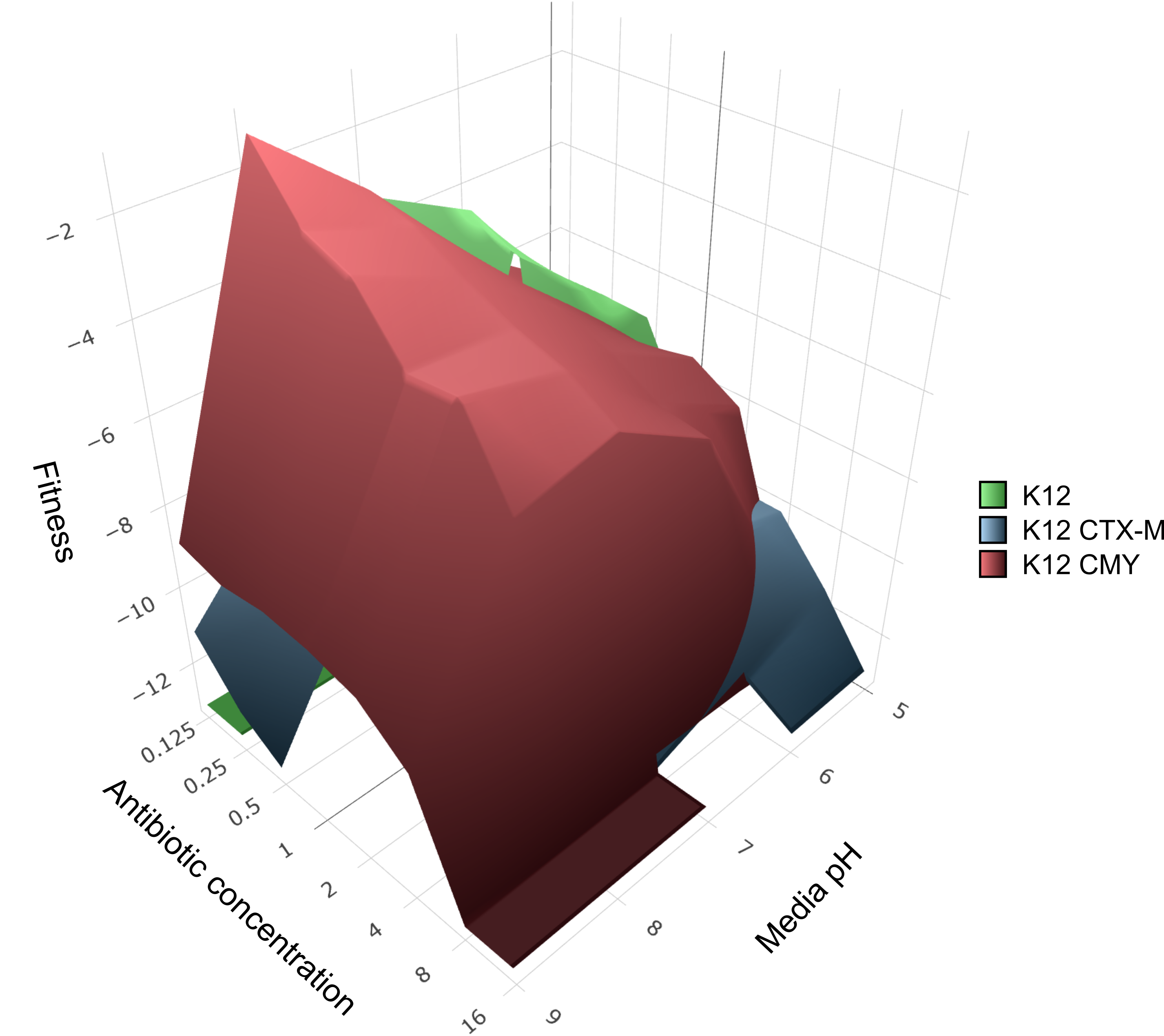
In this study, we explore how the effects of environmental variables (e.g. pH, temperature, oxygen pressure) affect the activity of antimicrobial genes. By studying two of the most common extended-spectrum beta-lactamases (ESBLs) CTX-M-15 and CMY-2, we find a contrasting effect of pH on their activity. E. coli carrying CTX-M-15 survives the highest concentrations of antibiotics when the environment is acidic, however the reverse seems to be the case for E. coli carrying CMY-2: they survive high concentrations in alkali environments. Using enzyme kinetics, we find a similar tendency, suggesting that enzyme activity and stability may be the causal mechanism. Importantly, this implies that our findings may be generalizable to all beta-lactamases and that the environment has played an understated role in the evolution, ecology, and spread of beta-lactamases. Finally, we explore how environmental conditions such as oxygen and pH may affect other beta-lactamases such as OXA-48-like proteins and NDM-like proteins.
Mikkel Anbo’s presentation