Frederik Duus Møller gave a presentation about LPAP (the Local Pathogen Analysis Platform), the local and offline side of the Global Pathogen Analysis Platform (GPAP). The presentation included a status update on the development of LPAP, and a look "under the hood" of how LPAP was designed and how it works.
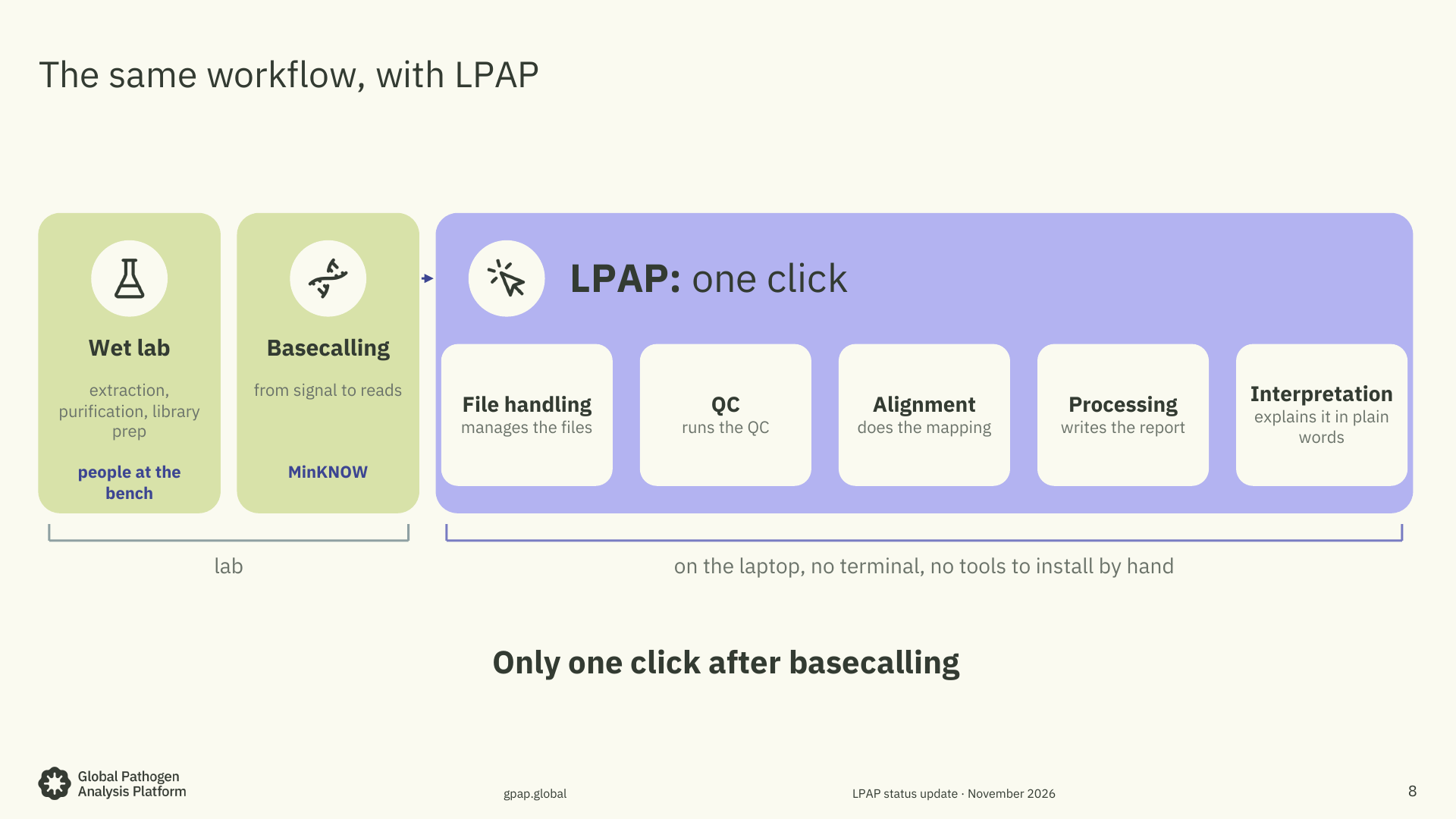
Sequencing has become portable: a Nanopore sequencer plugs into a laptop. The analysis has not followed. It still takes a terminal, installed tools, databases, a server and often a bioinformatician. LPAP is meant to close that gap. It is a free desktop app for Mac and Ubuntu Linux that turns Oxford Nanopore reads into an interactive report in a single click, with no command line, and works offline once it is set up.
Under the hood, LPAP runs the same KMA alignments and databases such as the CGE services ResFinder, SpeciesFinder, MLSTFinder etc., in pipelines for bacterial isolates, viruses and metagenomes. An optional AI model, running locally on the laptop, explains the report in plain words.
LPAP 1.0 is in final testing before public release. Next, it goes to GPAP co-creator workshops in Mexico, Thailand and Senegal.
Frederik Duus Møller’s presentation